
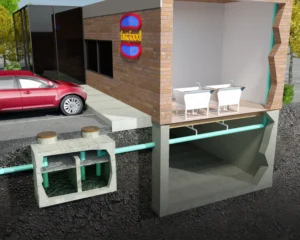
If you run a restaurant or food service business in Portland, you’ve probably dealt with your fair share of grease-related headaches. Maybe you’ve experienced slow drains during the dinner rush, foul odors coming from your kitchen drains, or worse: a complete backup that shut down your kitchen.
These problems often come down to improper grease management. A properly installed and maintained grease interceptor can save you thousands of dollars in repairs and keep your business running smoothly.
What is a grease interceptor?
A grease interceptor is a device that captures fats, oils, and grease (FOG) before they enter your wastewater system.
It has a specially designed tank that uses the natural separation of water and grease to protect your plumbing. When hot, greasy water flows from your kitchen equipment (dishwashers, sinks, floor drains), it enters the interceptor.
Think of it as a protective barrier between your kitchen and your septic system (or the municipal sewer lines). Without a trap or interceptor, FOG solidifies in your pipes like cholesterol in arteries, causing expensive blockages and backups.
Compared to grease traps, grease interceptors are larger, usually installed underground, and are better suited for bigger kitchens. Although they function similarly, traditional grease traps are better for smaller operations.
How does a grease interceptor work?
The process is actually simple, but incredibly effective. When wastewater from your kitchen flows into the interceptor, it slows down inside a tank. This gives the grease time to separate from the water. Since grease is lighter than water, it floats to the top, forming a layer we call a ‘grease cap.’
Meanwhile, food solids sink to the bottom, creating a sludge layer. The relatively clean water in the middle flows out to your septic system through an outlet pipe. This separation process takes time, which is why interceptors are sized based on flow rate and usage. During busy periods, if water moves through too quickly, grease doesn’t have time to separate and escapes into your pipes.
The key to keeping this process working smoothly is regular maintenance. When the grease cap gets too thick or the sludge layer builds up too high, your interceptor can’t do its job properly. That’s when you start noticing slow drains, gurgling sounds, and unpleasant odors. They’re all signs that your interceptor needs attention.
Click below and we'll call you back quickly!Ready to talk to a septic system expert?
Gravity Interceptors vs Hydromechanical Interceptors
Not all grease interceptors work the same way. The two main types (gravity and hydromechanical) each have their own advantages.
A hydromechanical grease interceptor is a compact unit that uses internal baffles or water flow to separate grease. These are typically installed under sinks or in mechanical rooms. They’re perfect for smaller operations or when space is limited, like coffee shops or delis.
The downside? They need cleaning more often (usually every two to four weeks).
Gravity interceptors are larger (holding 500-5,000 gallons) and usually installed underground outside your building. They use time and gravity to separate grease from water. While they cost more upfront, they can go months between cleanings. For high-volume restaurants, they’re often the better long-term investment.
How Septic Experts Can Help
Professional septic experts bring specialized knowledge and equipment that can save you money and prevent disasters before they happen. We at Speedy Septic solve possible underlying problems that cause kitchen failures.
If you’re looking for a new interceptor to be installed, our team will first help you determine the right size and type for your operation. We’ll analyze your menu, equipment, and volume to recommend the perfect FOG solution.
Regular professional maintenance is where we really shine. With our systematic approach, we measure grease and sludge levels, completely pump out all layers, pressure wash interior surfaces, and inspect all components for wear or damage.
We also spot problems before they become emergencies. A small crack in a baffle, unusual grease patterns, or signs of bacterial die-off can all indicate bigger issues brewing.
Call Us Today to Get Your Kitchen Running More Smoothly
Don’t wait for a grease-related disaster to shut down your business. If you’re experiencing slow drains, foul odors, or frequent backups, your grease interceptor probably needs attention. Even if everything seems fine, remember that prevention is always cheaper than emergency repairs.
Our team brings decades of Portland experience to every job. So whether you need routine maintenance, emergency service, or new installation, we’re here to help.
Contact us today for a free consultation and let us show you how proper grease management can save you money and headaches.